 Coinmarketcap
 Pair Volume in USD
Coinmarketcap (CMC) converts an exchange's reported 24-hour trading volume for a market pair into dollars using the quote asset's USD reference price. In LTC/BTC, BTC is the quote asset, so a quantity reported in BTC uses Bitcoin's dollar price. This produces a common currency figure for comparing trading activity. Asset totals and exchange totals then apply their own inclusion rules, so matching the currency does not necessarily make their underlying market sets match.
Last updated -
The Quote Amount's Effect on Dollar Volume
A pair's USD volume increases with more reported quote units when the reference price remains fixed, while a higher reference price increases that value when quote volume stays unchanged. The quantity tracks reported activity in quote units; the price assigns those units a dollar value.
Each input has a proportional effect when the other remains fixed. Both can move together, however, and their effects combine through multiplication. A rising dollar total can therefore reflect increased trading activity, a higher quote-asset price, or both. The dollar figure alone cannot distinguish those causes.
Base and Quote Units in a Market Pair
The quote asset determines the currency-conversion factor for the reported amount. In LTC/BTC, LTC identifies Litecoin as the base asset, and BTC identifies Bitcoin as the quote asset. The reported quote volume therefore has BTC units. Using Litecoin's dollar price against a BTC-denominated amount would mix incompatible units, even though both assets belong to the same trading pair.
Base-asset volume and quote-asset volume are different measurements. A raw number needs its unit before it can support a currency conversion. An amount already denominated in USD needs no further conversion to dollars. Multiplying that USD amount by another USD-per-BTC price would produce incorrect units.
The Conversion From Reported Units to USD
Coinmarketcap multiplies exchange-reported 24-hour pair volume in quote units by the quote asset's reference price in USD. The quantity and the reference price must concern the same quote asset. Writing the formula with units makes that requirement visible.
- The exchange supplies the pair's reported 24-hour volume in quote units.
- The quote asset's last known USD reference price supplies the conversion factor.
- Multiplication changes the reported quote amount into a derived USD volume.
- Any subsequent fiat conversion starts from that USD amount.
Let E denote the reported quote amount, C the USD price per quote unit, and D the derived dollar volume. The formula is
D = E × C
. Quote units cancel, leaving dollars.
A Hypothetical LTC/BTC Conversion
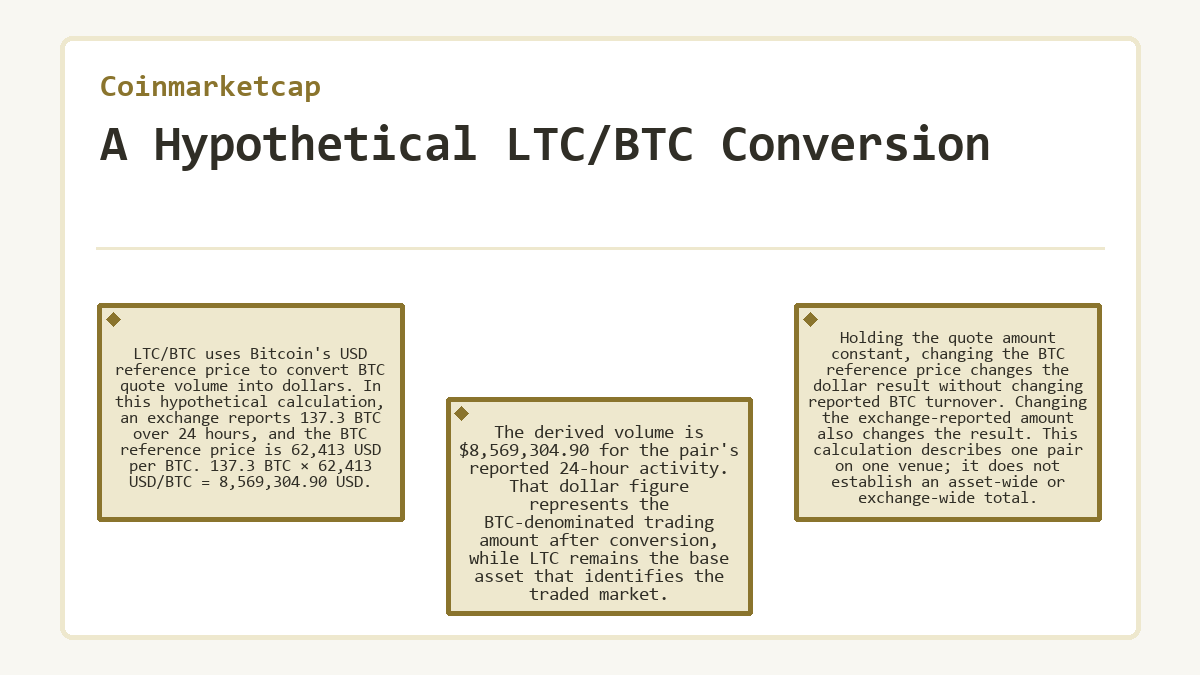
LTC/BTC uses Bitcoin's USD reference price to convert BTC quote volume into dollars. In this hypothetical calculation, an exchange reports 137.3 BTC over 24 hours, and the BTC reference price is 62,413 USD per BTC.
137.3 BTC × 62,413 USD/BTC = 8,569,304.90 USD
.
The derived volume is $8,569,304.90 for the pair's reported 24-hour activity. That dollar figure represents the BTC-denominated trading amount after conversion, while LTC remains the base asset that identifies the traded market.
Holding the quote amount constant, changing the BTC reference price changes the dollar result without changing reported BTC turnover. Changing the exchange-reported amount also changes the result. This calculation describes one pair on one venue; it does not establish an asset-wide or exchange-wide total.
Reference Prices and Individual Market Prices
The quote asset's reference price combines eligible market prices through volume weighting, so it can differ from a trade price on the selected exchange. Pairs contributing more volume have greater influence on that average. A venue's LTC/BTC trading price and Bitcoin's USD reference price have different roles. The conversion needs the latter because the reported volume has BTC units.
The volume methodology values the reported total using the quote asset's last known reference price, whereas summing individual trades at their separate execution-time USD prices would be a different calculation. Reproducing a converted amount therefore requires matching both its reported quantity and its conversion-price input. A later reference price can give the same quote quantity a different dollar value.
Pair Volume and Cryptoasset Volume
Cryptoasset volume combines 24-hour spot trading for an asset across exchanges, while pair volume describes a particular market. Common USD units make these amounts comparable in scale. The asset figure applies its own volume exclusions. An asset total depends on both the converted values and the included market set. Adding visible pair rows without respecting that set can produce a different sum. The aggregate cryptoasset-volume figure then adds individual asset volumes over the last 24 hours.
Exchange Totals and Volume Labels
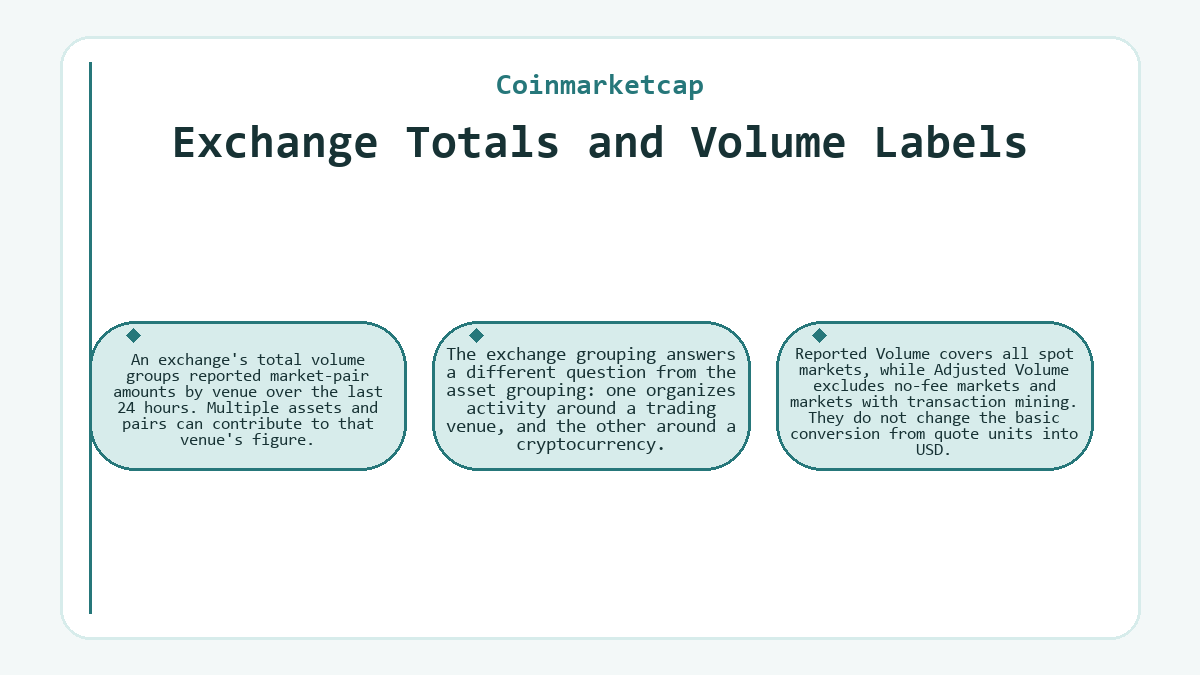
An exchange's total volume groups reported market-pair amounts by venue over the last 24 hours. Multiple assets and pairs can contribute to that venue's figure. The exchange grouping answers a different question from the asset grouping: one organizes activity around a trading venue, and the other around a cryptocurrency.
Reported Volume covers all spot markets, while Adjusted Volume excludes no-fee markets and markets with transaction mining. They do not change the basic conversion from quote units into USD.
USD Volume and Other Fiat Displays
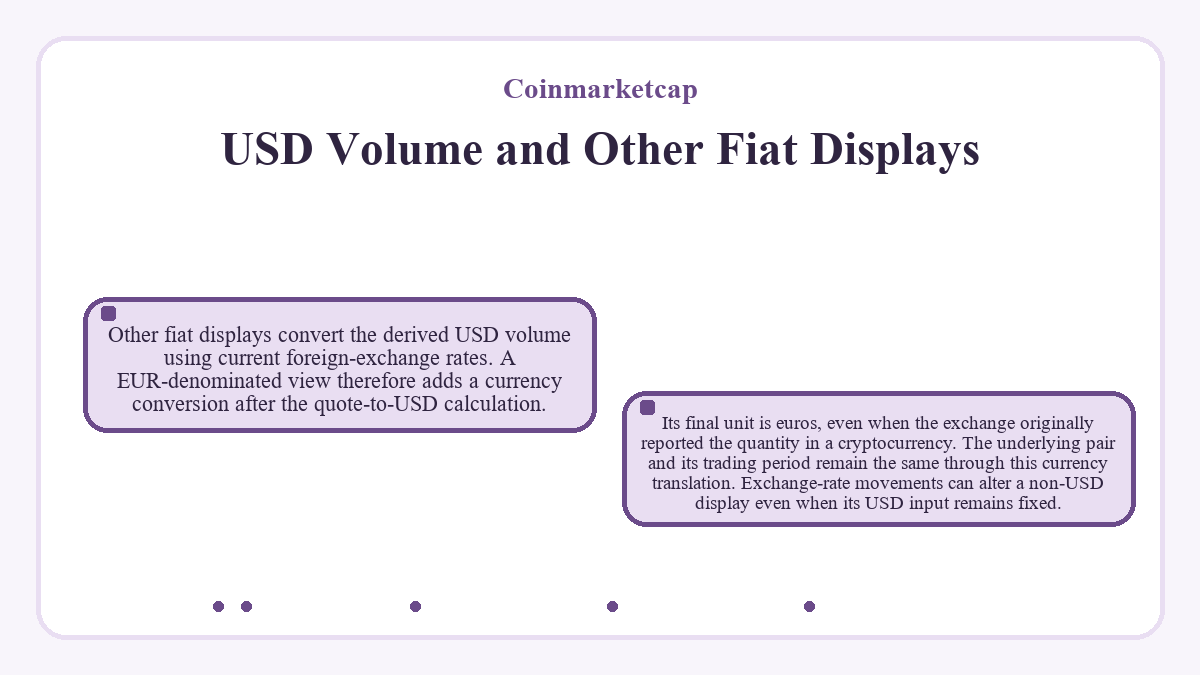
Other fiat displays convert the derived USD volume using current foreign-exchange rates. A EUR-denominated view therefore adds a currency conversion after the quote-to-USD calculation. Its final unit is euros, even when the exchange originally reported the quantity in a cryptocurrency. The underlying pair and its trading period remain the same through this currency translation. Exchange-rate movements can alter a non-USD display even when its USD input remains fixed.
Exclusions Across Different Calculations
Volume filtering changes an asset total when CMC detects a statistical anomaly in a market pair's reported activity. A double asterisk,
**
, identifies an anomalous-volume exclusion. The pair's quote amount can still convert into dollars even when that trading report falls outside the asset total.
The total exchange-volume calculation retains pair volumes that the cryptoasset calculation excludes, so differences in market inclusion can prevent the two aggregates from reconciling even when all amounts use the same currency.
Price exclusions operate on a different input. Restrictions on deposits or withdrawals, or regulatory barriers to access outside a geographical region, can make a market's price unrepresentative. CMC can exclude such prices from its reference average, along with significant price outliers. These rules change which prices contribute to the valuation input. Volume filtering instead changes which reported trading amounts contribute to an asset total.
Trading Turnover and Market Capitalization
Trading volume measures activity over a period, so its dollar total does not measure money newly deposited into an exchange. Assets can trade repeatedly during that period. Turnover therefore differs from the value of unique holdings or net capital inflows, even when all figures use USD.
Market capitalization uses a price and circulating supply, which measures a different quantity from trading volume. Sharing a currency unit does not make these metrics interchangeable. The interpretation changes when the input changes from a period's reported trading activity to an asset's circulating supply.
Helpful answers
-
Can Spot Volume and Derivatives Open Interest Be Added Into One USD Total?
- Spot volume and open interest describe different quantities, so their sum does not create a meaningful trading-volume total. Spot volume measures trading activity over a period. Open interest measures the value of outstanding, unsettled derivative contracts. Converting both into USD aligns their currency units without aligning what they measure.
-
How Can an API Integration Avoid Assigning Pair Volume to the Wrong Asset?
- An API integration should resolve asset identity through identifiers and metadata before interpreting pair volume. Ticker symbols can belong to more than one cryptocurrency. CMC provides cryptocurrency ID maps and metadata that help distinguish those records. The pair identifies its base and quote assets, while the returned field's definition determines whether the amount represents quote units or an already converted currency value.
-
Is a zero-fee Pair Automatically Omitted From a cryptoasset's 24-Hour Volume?
- Fee status alone does not trigger exclusion under the cryptoasset-volume rule that filters clear statistical anomalies. Adjusted Volume has a separate definition that excludes no-fee markets and markets with transaction mining. Reported Volume covers all spot markets.
-
When Do calendar-day Records Match a last-24-hours Volume Window?
- A calendar-day record and a last-24-hours volume figure cover the same period only when their time boundaries align. CMC generally records data in UTC unless otherwise specified, with historical daily opening and closing boundaries at 00:00 and 23:59 UTC. Those boundaries describe daily records; they do not automatically align every exchange-reported volume window. Currency conversion leaves the reported period unchanged.
-
Does a pair's USD Volume Show the Slippage of a Proposed Trade?
- A pair's USD volume measures reported turnover, while expected slippage concerns its liquidity. CMC's Liquidity Score supports comparisons of expected slippage, and its Confidence Indicator addresses the accuracy of reported volume. A dollar-volume amount alone does not specify the execution price of a proposed order. A Low Confidence reading also does not establish that wash trading occurred.