 Coinmarketcap
 portfolio - Balance Tracking and Value Updates
Coinmarketcap portfolio updates tracked holdings through manual transaction entries, supported on-chain addresses, and supported exchange connections. Automatic tracking follows the connected source; manual records reflect the information you enter. Its read-only design keeps monitoring separate from asset transfers, while market prices affect the displayed value.
Last updated -
Manual Records, Address Tracking, and Exchange Connections
Each tracking method draws holding information from a different source. You supply the transaction history for manual entry. Address tracking follows the connected address, while an exchange connection draws on supported account data. The distinction affects the work that balance tracking requires: manual records need attention when holdings change, whereas automatic tracking relies on the selected connection and its coverage.
A Balance Check Before Adding More Holdings
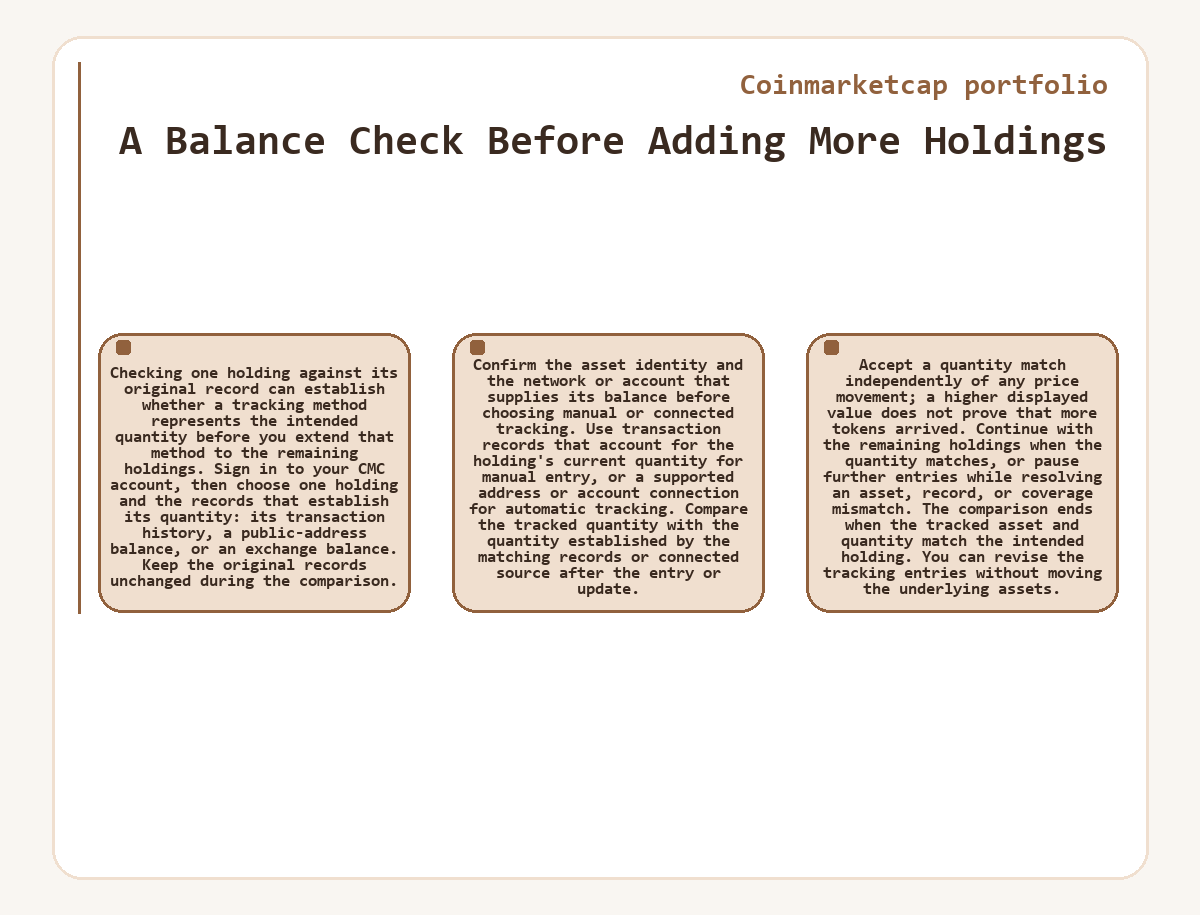
Checking one holding against its original record can establish whether a tracking method represents the intended quantity before you extend that method to the remaining holdings. Sign in to your CMC account, then choose one holding and the records that establish its quantity: its transaction history, a public-address balance, or an exchange balance. Keep the original records unchanged during the comparison.
- Confirm the asset identity and the network or account that supplies its balance before choosing manual or connected tracking.
- Use transaction records that account for the holding's current quantity for manual entry, or a supported address or account connection for automatic tracking.
- Compare the tracked quantity with the quantity established by the matching records or connected source after the entry or update.
- Accept a quantity match independently of any price movement; a higher displayed value does not prove that more tokens arrived.
- Continue with the remaining holdings when the quantity matches, or pause further entries while resolving an asset, record, or coverage mismatch.
The comparison ends when the tracked asset and quantity match the intended holding. You can revise the tracking entries without moving the underlying assets.
Recorded Transactions and Acquisition History
Manual entries record buys, sells, and transfers. The tracked quantity depends on the completeness and accuracy of those entries. A missing acquisition can understate the represented quantity. Recording the same acquisition twice can overstate it. Market price updates cannot correct either bookkeeping error because prices and transaction quantities describe different inputs.
Acquisition cost also differs from current market value. An original purchase record describes the quantity acquired and the price paid at that time. A current reference price values the holding now. Fees and execution details belong with the original records when they matter to the comparison; a current quantity alone cannot reconstruct them. An automatically tracked balance alone does not establish a complete acquisition history.
Connected Balances and Coverage Limits
Address-based tracking follows holdings at the connected address within supported coverage, while an exchange integration depends on the account data that its connection supplies. CMC Portfolio automatically updates balances from supported on-chain addresses. The address's network must be supported. A valid address does not establish that every asset or position associated with it appears in the tracker.
An address-based view also has a narrower scope than all the assets that someone owns. Holdings at another address or in a separate exchange account require their own representation. Combining supported connections and manual records can cover different locations, provided each record identifies a distinct holding. The location and the asset identity determine which quantity belongs in that record.
CMC Portfolio is read-only: it monitors holdings without holding user funds or enabling asset transactions. A public address can reveal activity on a public blockchain. Adding it to a portfolio associates that address with the tracking record, without granting authority to spend its funds. Keep private keys and recovery phrases outside the information needed to identify an asset or observe its balance.
What Changes When the Token Quantity Stays the Same?
A portfolio's displayed value can change while its recorded token quantity stays fixed because reference prices provide a separate, changing input to valuation. The value of a holding reflects its tracked quantity multiplied by its reference price in the valuation currency. A price movement can therefore alter the displayed total without a new acquisition, disposal, or transfer.
CMC calculates an asset's reference price through a volume-weighted average of eligible market-pair prices. A quote on an individual exchange can differ from that aggregate. The portfolio value expresses holdings at a reference price; a venue quote concerns the price available in that market. Market capitalization measures the size of an asset using circulating supply, while a personal portfolio uses the quantity that the holder actually owns.
Duplicate Holdings and Other Balance Mismatches
A mismatch between a portfolio and an original record can involve the represented quantity, the asset identity, the covered location, or the price used for valuation. Two displays can assign different currency values to the same token quantity.
Counting the same holding in a connected view and a separate manual record exaggerates exposure when both records enter the same total. Transfers between your own accounts create a related problem: moving an asset changes its location, without creating another copy of the holding. Transaction charges can affect the amount that remains. Identical labels can describe separate holdings; compare the source address or account before treating an entry as a duplicate.
Tickers can also be shared by different assets. Matching the symbol alone is insufficient when identifying a position. The asset record, network, and connected location provide more context. For automatic tracking, the relevant quantity belongs to the supported source; a connection that covers one location does not establish that every holding elsewhere has imported.
Watchlists, Alerts, and Held Quantities
Watchlists and price alerts follow selected assets, while a portfolio connects market information to recorded holdings and their quantities. A watched asset does not, by that fact alone, represent an owned position. An alert can notify you about a price condition without changing the holding record. You can also use them to follow assets that you do not hold. Neither interest in an asset nor an alert establishes an acquisition price or a completed purchase.
Native Tracking and Custom Portfolio Dashboards
A custom portfolio dashboard combines market data with holding records that its builder manages, whereas CMC Portfolio supplies a tracking workflow within the product. The API supports applications such as portfolio trackers and analytics tools. A price feed can supply valuation data, while a separate record provides the quantity owned.
Historical prices describe an asset's market history; they do not record changes to an individual's holdings. Reconstructing a portfolio value at an earlier time requires the holding quantities from that time alongside the relevant prices. Applying today's quantities to earlier prices values today's holdings at those past prices. This matters when acquisitions, disposals, or transfers changed the recorded positions.
Price refreshes and holding updates remain separate inputs in a custom dashboard. Retrieving a fresh quote does not establish that its quantity record has changed. A dashboard with current prices and outdated quantities can still display an inaccurate total.
The native tracker keeps supported holding inputs and market information within one tracking environment. A custom dashboard permits its own presentation and calculations. Its builder manages the data requests, holding records, and valuation logic.
Frequently asked questions about Coinmarketcap portfolio
Can I Monitor My Portfolio From the Mobile App?
The mobile app includes portfolio tracking, watchlists, and price alerts. Sign in with the same CMC account to access your web portfolio on mobile. Candlestick charts and daily open, high, low, close, and volume (OHLCV) data provide context for an asset's price history. Mobile portfolio tracking retains the product's read-only role; displaying a position does not transfer custody of its assets.
Does a Low Confidence Market Pair Mean My Portfolio Quantity Is Unreliable?
A Low Confidence rating assesses reported trading volume at the market-pair level. It does not test an imported wallet quantity or a manual transaction entry. The rating indicates that volume is less consistent with the supporting market signals evaluated by the model. It also does not, by itself, prove wash trading.
How Can CMC100 Differ From My Portfolio's Return?
CMC100 follows a market-cap-weighted selection of qualifying assets, so each asset's index weight can differ from its share of your portfolio's value. The benchmark excludes stablecoins and tokens pegged to other crypto assets. A personal portfolio also reflects its own acquisitions and disposals. Sharing some constituents with the index does not establish matching performance.
Must a Custom Portfolio Price Feed Use an API Key?
Supported Keyless Public API requests can retrieve portfolio pricing data without an API key. This route accepts GET requests for a selected endpoint catalog and shares IP-based rate limits. Keyed access provides higher limits, with specific data entitlements and licensing governed by the plan. A price response remains separate from the record that supplies your holding quantity.
Will a Manual Portfolio Entry Prove That a Learn & Earn Reward Arrived?
A manual portfolio entry does not prove that a campaign reward reached its recipient. The project issues and distributes Learn & Earn tokens under the campaign terms. Completing educational tasks and receiving tokens are separate events. Delivery evidence concerns the actual project token at the designated recipient wallet or distribution account.